
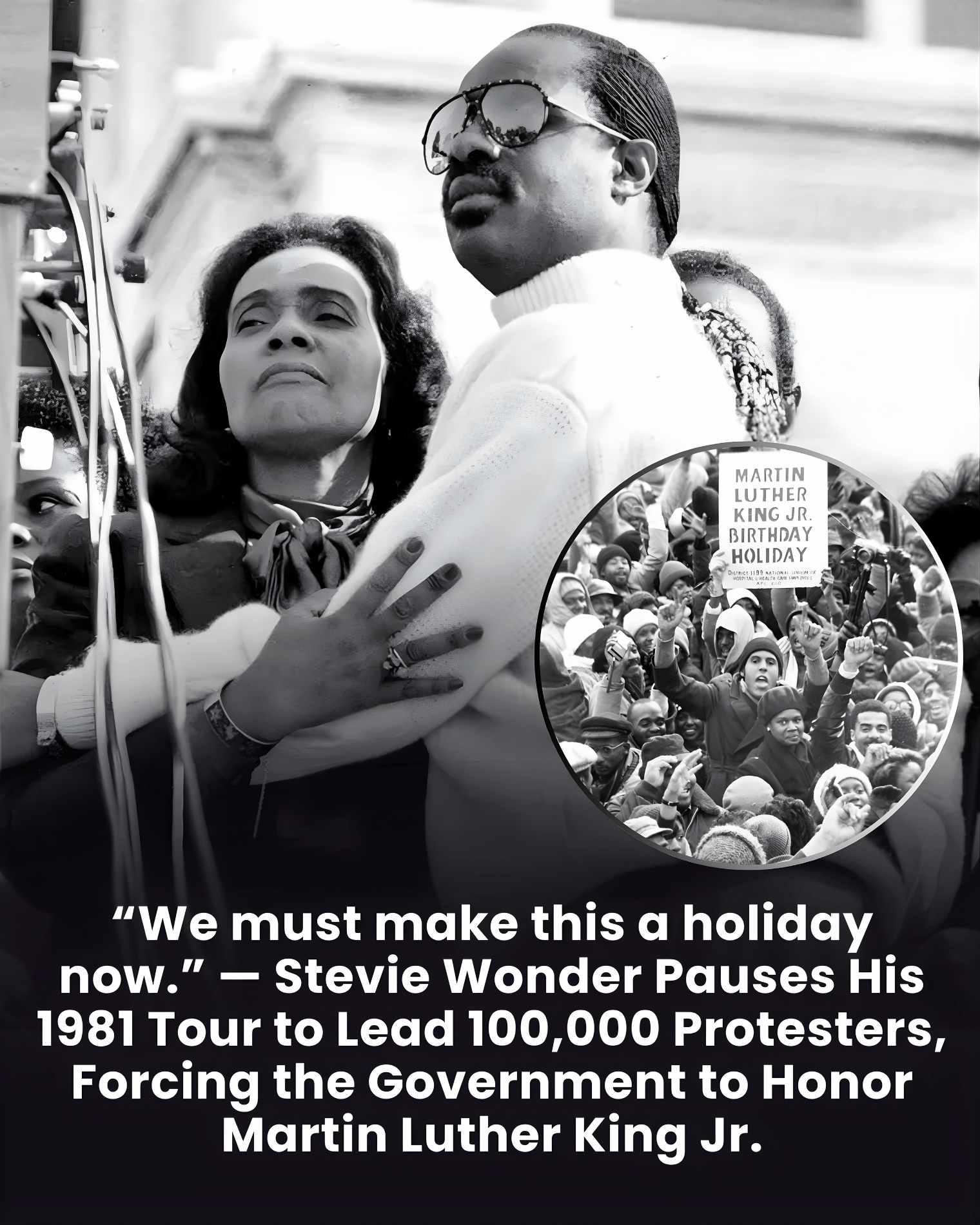
In the early 1980s, Stevie Wonder proved that music could be far more than entertainment—it could become a powerful force for political change. Already celebrated as one of the most influential musicians of his generation, Wonder chose to use his fame and platform to fight for a cause he believed the United States had long ignored: establishing a national holiday to honor Dr. Martin Luther King Jr.
Although Dr. King had been assassinated in 1968, more than a decade later the country still had not officially recognized his birthday as a federal holiday. For many civil rights leaders and activists, the absence of such recognition felt like a failure to fully acknowledge King's contributions to American history and the ongoing struggle for equality.
Stevie Wonder found that unacceptable.
In 1980, he released the song "Happy Birthday," a vibrant and joyful track from his album Hotter Than July. While the song sounded like a celebration on the surface, it carried a clear political message. Wonder wrote it specifically as a call to action, urging lawmakers and citizens to recognize King's birthday as a national holiday.
The song quickly became an anthem for the movement.
Rather than limiting his support to music, Wonder took his activism directly to the public stage. During his 1981 tour, he paused his performances to dedicate time to organizing rallies and speaking out about the issue. His message was simple but powerful: if the country truly valued justice and equality, it should formally honor the man who symbolized that struggle.
One of the most dramatic moments came when Wonder helped organize a massive rally at the National Mall in Washington, D.C. The event drew an enormous crowd—more than 100,000 people gathered to support the cause. Civil rights leaders, activists, and families traveled from across the country to participate in the historic demonstration.
Standing before the crowd, Wonder spoke passionately about the importance of remembering Dr. King's legacy. Beside him was Coretta Scott King, the widow of the civil rights leader, who had spent years advocating for the same recognition.
Together, they presented a petition carrying an astonishing six million signatures from Americans who supported the creation of the holiday. The overwhelming number of signatures demonstrated that the movement had grown far beyond a small group of activists—it had become a national demand.
The pressure created by the campaign, combined with Wonder's influence and the widespread public support, helped push the issue into the center of political debate in Washington.
Two years later, the effort achieved its goal.
In 1983, President Ronald Reagan signed legislation officially establishing Martin Luther King Jr. Day as a federal holiday. The law marked a historic moment in American civil rights history, ensuring that King's legacy would be recognized nationwide.
The first official observance of the holiday took place in 1986.
For Stevie Wonder, the victory represented proof that artists could help shape society beyond the stage. His music had energized the movement, while his activism helped transform public support into political action.
Decades later, Martin Luther King Jr. Day remains a powerful reminder of the struggle for equality—and of the unexpected role a musician played in helping bring that recognition to life. Through determination, music, and public advocacy, Stevie Wonder helped turn a song into a movement and a dream into a national holiday.
View this post on Instagram